A justice framework to guide governance
16/09/2026
What does justice mean when we talk about staying within the limits of the planet? Earth Commissioners presented a refined Earth System Justice framework at a conference with governance experts last week.

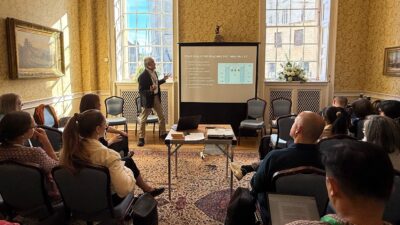
Governance scholars from all over the world gathered for the annual conference of the Earth System Governance Project, “Building Just and Sustainable Futures for Planetary Integrity”. It took place in Bath, a venue loaded with governance history: Bath Abbey, which served as the location for the opening plenary, is where the first king of England was crowned.
At the conference, members of the Earth Commission explored questions of inequality and planetary pressure. Presenting were Joyeeta Gupta and Juan Camilo Cardenas, co-leads of the Justice, Governance and Economics workstream, as well as former Commissioner Diana Liverman, program manager Lisa Jacobson and secretariat researcher Raimon Cardelús Ylla-Català.
How to define just boundaries?
In a session during the conference, the team asked for input on its recent work to refine the Earth System Justice framework. The Earth Commission has already concluded that justice is a prerequisite for a stable planet, and identified just boundaries and minimum levels of access to ensure a dignified life for all.
In the Commission’s second assessment, the methodology for identifying just boundaries is being updated to make it more systematic and reproducible. A key challenge is determining what counts as “significant harm”.

“We have identified a set of criteria and steps for how to set just boundaries. A very important challenge is to define what is ‘significant’ when it comes to harm. Can we accept 1 percent of the population being harmed? That is much more than ‘leave no one behind’. And yet, at the current level of climate change, tens of millions are harmed. How can we accept this?”, Joyeeta Gupta, Professor of Environment and Development of the Global South, University of Amsterdam, said during her presentation.
What level of inequality is acceptable?
Juan Camilo Cardenas, Professor of Economics at Universidad de los Andes in Colombia and the University of Massachusetts Amherst, US, presented the Commission’s new work on how inequalities impact the Earth system.

“Too much inequality erodes the social contract and willingness to work together to solve the planetary crises we are experiencing,” he said. “But, within ‘acceptable inequalities’ we could allow the poorest to meet a dignifying level of life, reduce overconsumption on the other hand and live well within the limits of the planet.”
In the discussions that followed, participants emphasised that many local communities already understand the need for boundaries, but that these boundaries need to be contextualized to local realities. The conversation also focused on several options to limit inequalities, and reduce over consumption – such as taxes on fast fashion or unhealthy foods.
The discussion will feed into the Commission’s ongoing work as it finalizes several new papers on justice, governance and economics.
The Earth System Governance Project is one of 25 global research networks within the Future Earth family.